Sleep Apnoea and Snoring: How an ENT Doctor Provides the Solution
Snoring is often dismissed as a trivial annoyance, but for many, it can be a sign of something more serious. If you or someone you love snores loudly and regularly, it may be time to consider the underlying cause. An ENT assessment goes beyond just checking the nose and throat—it’s about uncovering and treating potential threats to your overall health.
An ENT (Ear, Nose, and Throat) specialist is uniquely positioned to evaluate snoring and sleep apnea. If snoring is starting to affect your life, a targeted evaluation by an ENT doctor could make all the difference.
How ENT Specialists Assess Snoring and Sleep Apnoea
Recognising the Signs: When Snoring Signals a Problem
While not all snoring is a cause for alarm, certain warning signs should prompt further evaluation. Snoring accompanied by frequent pauses in breathing, gasping or choking during sleep, or excessive daytime sleepiness may indicate obstructive sleep apnea (OSA). People with OSA often feel unrefreshed upon waking and may struggle with concentration, memory lapses, or irritability throughout the day.
Children are not immune to sleep apnoea either. If your child snores, is unusually tired during the day, or has difficulty focusing at school, these symptoms should not be overlooked. Early diagnosis and intervention can be especially important for young patients.
The ENT Examination: Comprehensive and Individualised
An ENT doctor’s assessment for snoring and sleep apnoea is thorough and highly individualised. The first step is usually a detailed medical history and symptom review. Your ENT will want to know about your sleep patterns, any witnessed apnoeas (pauses in breathing), and related health issues such as high blood pressure or weight gain.
A physical examination follows, with special attention to the nose, throat, tonsils, adenoids, and neck. ENT specialists are trained to identify anatomical causes of airway obstruction such as a deviated nasal septum, enlarged tonsils, or abnormal tongue position.
In some cases, a flexible nasoendoscopy is performed. This is a simple and well-tolerated procedure that lets your ENT directly observe your upper airway structures. If a more detailed assessment is required, imaging studies such as CT or MRI scans may be used to visualise potential blockages.
Sleep Studies: Pinpointing the Severity
To confirm a diagnosis of sleep apnoea and guide treatment, your ENT doctor may recommend a sleep study (polysomnography). This overnight test records brain activity, oxygen levels, breathing patterns, and heart rate while you sleep. For some patients, a drug-induced sleep endoscopy (DISE) can provide further insight by identifying precisely where the airway collapses during sleep.
By combining clinical expertise with advanced diagnostic tools, ENT specialists deliver a comprehensive evaluation that lays the groundwork for effective sleep apnea treatment.
ENT-Led Treatment Pathways
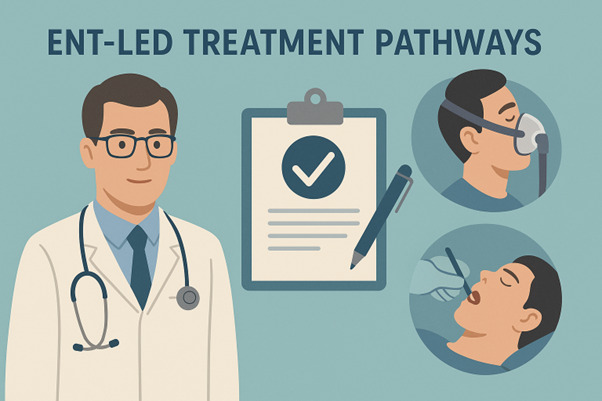
Non-Surgical Management: The First Line
Most people with snoring or mild sleep apnoea begin with non-surgical management. Continuous Positive Airway Pressure (CPAP) therapy is one of the most effective solutions, keeping the airway open by delivering a gentle stream of air through a mask. Some patients may benefit from custom-fitted oral appliances or mouthpieces, which reposition the jaw or tongue to prevent airway collapse.
Lifestyle changes are equally important. Weight management, reducing alcohol intake, and avoiding sedative medications can make a significant difference for many people. Your ENT doctor will tailor recommendations based on your unique anatomy and lifestyle.
Surgical Options: Addressing Anatomical Causes
For patients who do not respond to non-surgical treatment or have specific anatomical blockages, surgery may be advised. ENT surgeons are skilled in procedures that can improve airflow and reduce or eliminate snoring.
Common surgical interventions include septoplasty (to correct a deviated nasal septum), turbinate reduction (to address swollen nasal tissues), and uvulopalatopharyngoplasty (UPPP) to remove excess soft tissue in the throat. Children with sleep apnoea often benefit from tonsillectomy or adenoidectomy, especially when enlarged tonsils or adenoids are the main contributors to airway blockage.
In selected cases, advanced procedures such as tongue suspension or hypoglossal nerve stimulation can help stabilise the airway during sleep.
Paediatric Considerations: Special Attention for Children
Children present unique challenges when it comes to snoring and sleep apnoea. Unlike adults, children with sleep apnoea may exhibit behavioural issues, learning difficulties, or stunted growth in addition to typical symptoms like loud snoring or restless sleep.
ENT specialists are experienced in diagnosing and managing sleep-related breathing disorders in children. Early treatment, particularly for those with enlarged tonsils or adenoids, can lead to dramatic improvements in quality of life, behaviour, and academic performance.
ENT-Led Treatment Pathways
Untreated sleep apnoea is not just a nightly inconvenience—it can have serious health consequences. Regular pauses in breathing cause drops in blood oxygen, placing stress on the heart and vascular system. Over time, this increases the risk of high blood pressure, stroke, heart disease, and even diabetes.
Daytime fatigue from fragmented sleep can lead to poor concentration, workplace accidents, and a higher risk of motor vehicle accidents. In children, chronic sleep disruption may impair cognitive development and emotional wellbeing.
The cumulative effects of untreated sleep apnoea can be profound, but the good news is that targeted treatment can dramatically reduce these risks. Seeking help from an ENT doctor ensures you receive the correct diagnosis and the most effective intervention.
When to See an ENT Doctor
Not every case of snoring requires a specialist. However, if you—or your bed partner—notice loud, regular snoring interrupted by pauses in breathing, choking, or gasping, it’s time to seek expert care. Other warning signs include excessive daytime sleepiness, morning headaches, and difficulty concentrating. For children, attention problems, hyperactivity, or growth concerns may also be signs of a sleep-related breathing disorder.
Prompt assessment by an ENT specialist can identify the underlying cause and initiate a personalised treatment plan. Addressing the issue early helps safeguard your long-term health and restore restful, restorative sleep.
During your first visit to an ENT clinic, the doctor will usually review your symptoms, medical history, and sleep patterns. You may be asked about snoring, breathing pauses during sleep, daytime fatigue, and any existing health conditions.
A physical examination of your nose, throat, and airway may also be performed to identify potential causes of obstruction. In some cases, the ENT specialist may recommend a sleep study to confirm the diagnosis and determine the severity of the condition, allowing the most appropriate treatment plan to be developed.
Conclusion
Snoring may seem like a simple nuisance, but it is often the body’s way of alerting us to a more significant problem. If you suspect you may have sleep apnoea, or if you are struggling to find a solution to persistent snoring, consult an ENT doctor. Sleep apnea treatment Singapore and around the world begins with an accurate diagnosis and a comprehensive, individualised approach.
Don’t ignore the signs—protect your health, improve your quality of life, and reclaim your nights. An evaluation by a trusted ENT specialist is the essential first step towards a safer, quieter, and more refreshing sleep.